The olympic lifts occupy a strange place in modern strength training. On one hand, they are among the most powerful tools ever developed for expressing force quickly. On the other, they are routinely misused, poorly taught, and force-fit into programs where they add complexity without clear return.
Most athletes are not weightlifters. They do not need to compete in the snatch or clean & jerk. Yet many still attempt to train like they are, often without the technical background, mobility profile, or training context that makes Olympic lifting productive rather than chaotic.
The question is not whether Olympic lifts are “good” or “bad.”
The question is how to extract their benefits without inheriting their costs.
What Olympic Lifts Actually Train (From a Physiological Standpoint)
At their core, Olympic lifts are high rate of force development tasks performed under moderate external load with minimal deceleration phases. This combination is relatively rare in strength and conditioning.
Most resistance exercises fall at one of two ends of the spectrum. They are either high force and low velocity, as in squats and deadlifts, or low force and high velocity, as in jumps and sprints. Olympic lifts sit in the middle. They allow relatively heavy loads to be moved quickly, which is why they are often positioned as a bridge between maximal strength and pure speed. Physiologically, they emphasize rapid motor unit recruitment, intermuscular coordination, triple extension under load, and trunk stiffness under dynamic conditions.
In theory, this makes them an excellent general power stimulus. In practice, however, they are also highly technical and easy to turn into slow strength lifts performed in poor positions. This is where most problems begin.
Why Most Non-Weightlifters Get Little From Full Olympic Lifts
The full snatch and clean are not simply power exercises. They are sport skills. They require precise timing, high positional tolerance, repeated technical exposure, and constant coaching feedback. Without those conditions, the lifts stop functioning as true power training and drift into poorly executed technical drills.
If someone performs Olympic lifts once or twice a week, often in a fatigued state, and without a deliberate technical development plan, what they are really doing is continuing to rehearse flawed movement patterns at moderate speed. At that point, the lifts no longer train maximal power, maximal strength, or even technical proficiency. Instead, they become risky, energetically expensive versions of movements that could be trained far more cleanly with simpler tools
The Core Principle: Train the Output, Not the Sport
For non-Olympic weightlifters, the goal is not to master Olympic lifting. The goal is to train power expression.
That means fast intent, moderate loading, clean movement, and minimal technical bottlenecks. The mistake is assuming that the full Olympic lifts are the only way to achieve those qualities, which they are not.
Olympic lifts are simply one method among many for expressing force quickly under load. For most non-weightlifters, similar or in some cases better power adaptations can be achieved with far simpler tools, such as loaded jumps, medicine ball throws, kettlebell swings, sled pushes and drags, and variations of the push press or jump squat.
All of these options share similar underlying features in that they are performed with high intent, use moderate external loading, carry a low technical cost, and are easy to progress over time. And unlike full Olympic lifts, they require minimal mobility, are able to be loaded across a much wider range of populations and can integrate seamlessly into most programs. In other words, they train the same output but with fewer constraints.
Why Olympic Variations Still Matter
If full Olympic lifts are not required, and simpler tools can train power just as well, why use Olympic-style movements at all?
Because Olympic variations occupy a useful middle ground.
They allow everyday athletes to express force quickly under load without taking on the full technical burden of the sport lifts. They preserve the most valuable physiological qualities of Olympic lifting, while removing many of the constraints that make the full snatch and clean impractical for most populations.
In other words, they are not attempts to become better weightlifters. They are tools for training power in a way that still feels athletic, coordinated, and transferable to real movement.
When used correctly, Olympic variations act as a bridge between pure strength work and lower-load power work. They sit above jumps and throws in terms of external loading, but below full Olympic lifts in terms of technical demand.
That is where their real value lies.
The High-Return Olympic Lift Variations
These variations preserve the useful physiology while removing most of the technical tax.1.
1. Hang Clean
The hang clean removes much of the complexity of lifting from the floor while preserving aggressive extension, speed under the bar, and meaningful loading.
It is easier to teach, easier to repeat, and far more forgiving when time and recovery are limited.
For many athletes I program for, this becomes the default Olympic-style lift.
2. Clean Pull from Blocks or Pins
Removing the catch allows maximal intent without the mobility and timing demands of receiving the bar.
Athletes can focus entirely on force production and vertical finish. Loads can climb, output rises, and technical failure drops.
In many training environments, this produces better power development than full cleans.
3. Snatch or Clean High Pull
High pulls reinforce violent hip extension and proper bar proximity while remaining simple enough to coach athletes remotely or in large groups.
They sit in the middle ground: more dynamic than pulls, less demanding than catches.
You get most of the stimulus without the learning curve.
4. Push Press
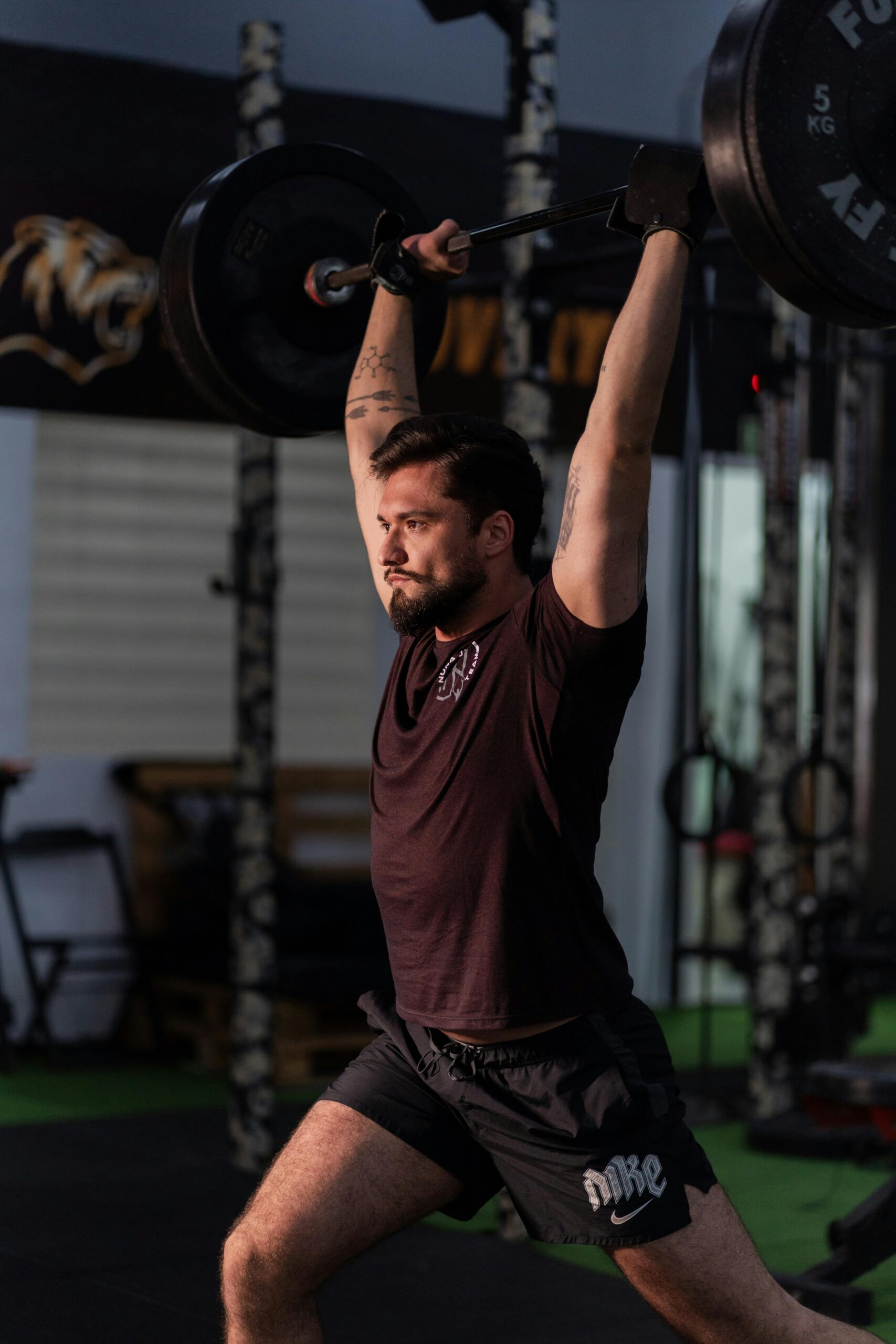
The push press is one of the most practical power movements available.
It teaches coordination between lower and upper body, tolerates heavier loading than strict pressing, and is straightforward to progress.
For many athletes, it provides more useable transfer than the jerk with far less technical overhead.
When and How Everyday Athletes Should Use Olympic Lifts
Olympic variations should live early in the session, under low fatigue, for low reps, with high intent.
Full Olympic lifts still have a place, but only under specific conditions. They make sense when someone genuinely enjoys them, has access to competent coaching, and is able to train them consistently with true technical progression. In those cases, the lifts function as both power training and sport practice.
They make far less sense when they are treated as accessories or performed in a fatigued state as a conditioning movement. When they compete with key strength work or delay recovery, they become even more impractical.
For most everyday athletes, the full Olympic lifts should be treated as optional skill work rather than mandatory training staples. When they are used, they should be programmed early in the session, when fatigue is low, and for low reps and high intent. In practical terms, this usually means 3 to 6 sets of 2 to 4 repetitions, using roughly 60-80% of estimated 1RM, with full recovery allowed between sets. They are not conditioning tools. They are neural power stimuli. This loading range tends to maximize the balance between force production and movement velocity, allowing athletes to express high power outputs without excessive technical degradation.
The table below summarizies how common Olympic-style variations fit into a practical training framework for everyday athletes.
Olympic-Style Options for the Everyday Athlete
| Category | Movement | Primary Role | When to Use | Typical Loading |
| No catch | Clean or Snatch Pull from Blocks | Heavy power expression | When strength is high but speed is lagging | 70–90% clean 1RM |
| No catch | Clean or Snatch High Pull | Lighter, faster power | When teaching bar path or emphasizing velocity | 50–70% clean 1RM |
| Minimal catch | Hang Clean | General power development | Default Olympic-style movement for most athletes | 60–80% clean 1RM |
| Upper-body power | Push Press | Lower-to-upper force transfer | When overhead strength and power are priorities | 60–80% press 1RM |
| Minimal skill | Jump Shrug | Pure hip extension | Teaching triple extension or early in programs | 30–60% clean 1RM |
| Light technical | Muscle / Power Snatch | Coordination and speed | Low load, low stress power work | 40–60% snatch 1RM |
Practical loading guidelines:
- 3–6 sets
- 2–4 reps
- 60–80% of estimated max
- Full recovery between sets
The Bottom Line
Olympic lifts are not magical or a requirement for good training. They also are not dangerous by default. They are simply tools in a bottomless toolbox. Used intelligently, Olympic style lifts are excellent for expressing strength quickly and adding athletic intent to a training program. But alternatives exist that may make training safer and, in some cases, more effective than living or dying by the Olympic lifts.