The idea of a “recovery supplement” is so embedded in our modern fitness culture that it often goes unquestioned. If you train hard, you are expected to take something afterward. A power, a capsule, a drink. Something designed to “speed recovery.”
But before asking which supplements work, a more important question comes first:
What do we actually mean by recovery?
And even more critically:
What problem are these supplements trying to solve in the first place?
So, What Do We Mean by Recovery?
In casual conversation, recovery usually means some combination of feeling less sore, less fatigued, or more ready to train again. While those experiences matter, they are not the same thing as physiological recovery.
From a performance standpoint, recovery is the restoration of the body’s ability to produce force, sustain effort, and tolerate training load. In other words, it is the return of functional capacity.
In research settings, recovery is often operationalized using a mix of performance outputs and physiological markers, including indicators of muscle damage, inflammation, and oxidative stress. These might include biomarkers such as creatine kinase (a marker of muscle damage), inflammatory cytokines like IL-6, or lipid peroxidation markers associated with oxidative stress.
These serve as proxies for how much structural and metabolic stress the body experienced, and how aggressively the immune system is responding to that stress. They are useful for understanding the stress response, but they are not the same thing as being fully recovered.
A reduction in soreness, inflammation, or oxidative stress does not automatically translate to restored performance capacity. Feeling recovered and being recovered are not identical physiological states.
What is a “Recovery Supplement”?
Most products marketed as recovery supplements are designed to influence one or more of the following:
- Muscle damage
- Inflammation
- Oxidative stress
- Stress hormones
- Perceived soreness or fatigue
- Sleep quality
Examples include tart cherry products, curcumin, magnesium or ZMA, omega-3 fatty acids, BCAAs or EAAs, adaptogens, and similar compounds.
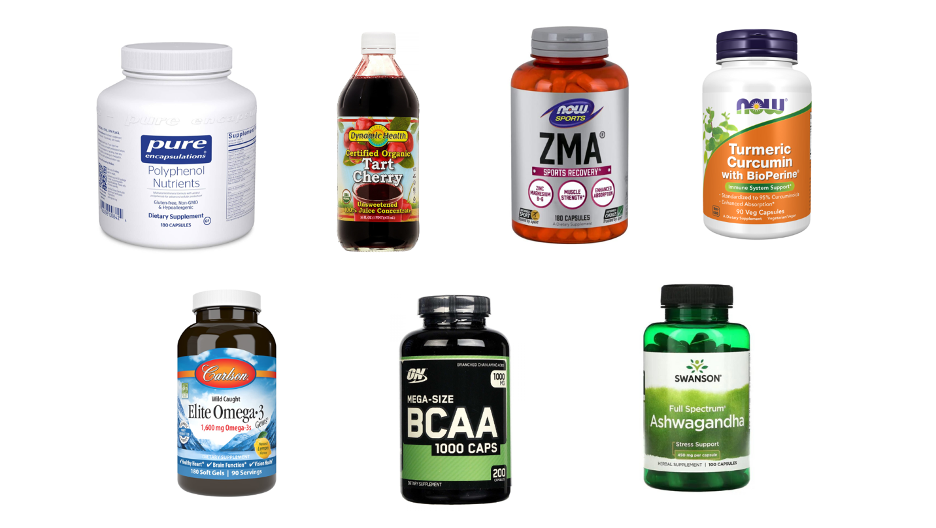
The common thread across nearly all of them is that they attempt to modify how the body responds to stress, not how the body rebuilds capacity after stress.
Which raises an uncomfortable but important point. None of these supplements supply the primary substrates that are required for recovery.
Most recovery supplements are built around a subtle but flawed assumption:
If we reduce markers of inflammation, muscle damage, or oxidative stress, then recovery must improve.
This makes intuitive sense. Inflammation feels bad. Muscle damage sounds bad. Oxidative stress sounds bad. Therefore, lowering them must be good.
But in physiology, “lower” doesn’t always mean “better.”
These processes are part of the normal adaptive response to training. They reflect stress, remodeling, and signaling. Reducing their magnitude does not necessarily restore energy availability, neuromuscular function, or training capacity.
The actual foundations of recovery are far less exotic:
- Training volume and intensity
- Total energy intake
- Carbohydrate availability
- Sleep
- Basic hydration and electrolytes
These determine whether the body can rebuild itself. Most recovery supplements operate downstream of these variables. They attempt to smooth the experience of fatigue, not resolve its root cause.
The Real Recovery Stack (and Why It’s Boring)
If recovery is defined as restoring the ability to perform, then the primary limiting factors are almost always:
- Insufficient energy intake
- Insufficient carbohydrate
- Insufficient sleep
- Excessive training load
Carbohydrate, in particular, is often the single most important variable in recovery, especially in endurance and hybrid athletes. Muscle glycogen availability directly influences subsequent performance, perceived effort, training quality, and central fatigue.
No amount of antioxidant signaling can compensate for an empty fuel tank.
Protein supports structural repair and muscle protein synthesis, but once intake is sufficient, it is rarely the main bottleneck in recovery. It does not restore glycogen, and it does not normalize neuromuscular fatigue.
From a physiological standpoint, the true “recovery supplements” are not supplements at all. They are food, sleep, and training load management. Everything else is secondary modulation.
None of this is to say recovery supplements are useless. Many of them do influence the subjective experience. They may acutely reduce soreness, improve your sleep quality, or lower perceived stress. Placebo alone can meaningfully affect how recovered an athlete feels.
And this impacts many downstream factors, because perception, and confidence, and training adherence all matters. But subjective readiness and physiological readiness are not the same thing. Most recovery supplements operate on the level of how fatigue feels, but not how fatigue is generated. They rarely restore energy availability, output, or work capacity in any meaningful way.
However, its important to consider that context matters. There are scenarios where recovery supplements may play a supporting role, particularly:
- During heavy caloric restriction
- In older athletes
- In elite athletes
- Under high training volume
- During travel or sleep disruptions
- In individuals with various nutrient deficiencies.
In these contexts, small effects can matter a great deal. But even then, supplements adjuncts to the fundamental drivers of recovery.
Where This Goes Next
Many of the common recovery ingredients will be examined in detail in future articles. Tart cherry, curcumin, magnesium, omega-3s, adaptogens, and others all have distinct mechanisms and specific contexts where they may be useful.
The goal here is not to decide which supplement is best, but to decide whether the category itself deserves the priority it received.
Because before debating ingredients, doses, or protocols, the more important question is simpler:
Are you actually recovering… or just treating the symptoms of not doing so?