Walk into almost any gym and you’ll see the same scene at the end of a workout. People grab a mat, drop to the floor, and start grinding through crunches, toe-touches, or long planks. The goal is usually simple: feel the burn, get a pump, maybe carve out some visible abs. You’ll see it even more as summer approaches and everyone starts chasing that poolside look.
The intentions are good, but the approach misses the point.
Yes, most of you care how your abs look. And most of you training today aren’t professional athletes. You’re parents, professionals, former competitors, and everyday high performers who want to stay capable, look good, and feel strong for decades. But the way we’ve been taught to train the “core” still comes from bodybuilding magazines and group fitness culture, and it continues to shape what happens in the gym.
High-repetition sets. Bodyweight floor exercises. Endless chasing of the burn.
Real trunk training looks different.
You don’t train it just to feel muscles working or to check a box at the end of a session. Training the trunk carries performance benefits, but it also supports long-term durability and healthspan. You train it to control motion, transfer force, and hold position under load.
The trunk isn’t a beach muscle. It functions more like a transmission system. When it does its job well, force moves efficiently from the ground through the hips and torso into the upper body. When it doesn’t, power leaks, mechanics break down, and stress shifts to places that don’t tolerate it well. That matters whether you’re sprinting, lifting heavy, hauling mulch, wrestling with your kids on the floor, or trying to keep your back from barking after a long week at a desk.
It’s also why I’ve largely moved away from the buzzword phrase “core training.” I talked about this in an Everyday Strength Podcast episode titled “Why I Don’t Call It ‘Core’ Training.” Language shapes how we think and how we train. When people hear “core,” they think abs. When we think trunk, we think stability and force transfer.
If your spine moves when it shouldn’t, performance suffers and durability follows close behind. From a practical standpoint, the trunk runs from the base of your ribcage down through your pelvis and hips. Its primary job is not to create movement but to resist unwanted motion of the spine and the lumbo-pelvic-hip complex. Stability comes first. Movement comes second.
You see this everywhere:
- Picking up a heavy box off the floor
- Carrying groceries from the car
- Shoveling snow in the winter
- Standing and moving for hours at work
- Lifting weights after sitting all day
In each of those situations, your trunk’s job is to keep your spine and pelvis in a strong, controlled position while force moves through your body. That control sets the stage for power.
Understanding the Trunk in Layers
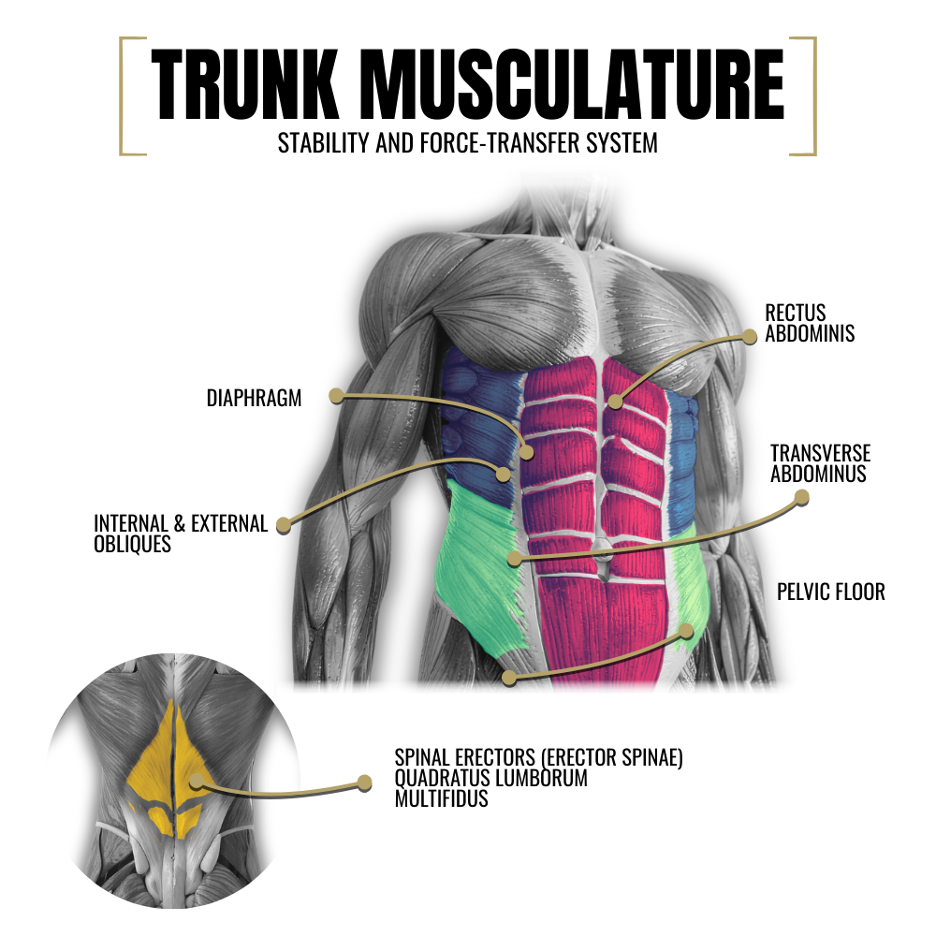
A helpful way to understand trunk function is to think in layers. Each layer has a role, and they work together as a coordinated system.
| Layer | Primary Role | Key Muscles | Example Function |
| Deep Stabilizers | Pressure control and segmental stability | Diaphragm, pelvic floor, transverse abdominis, multifidus | Bracing before a lift |
| Global Stabilizers | Anti-rotation and anti-collapse control | Obliques, quadratus lumborum, glute medius, proximal adductors | Carrying uneven loads |
| Global Movers | Force production and large movement | Rectus abdominis, erector spinae, lats, superficial glutes | Heavy lifting and powerful movement |
Deep Stabilizers
The deep layer provides local stability and pressure control. These muscles create a stable foundation for everything else to work from. The diaphragm, pelvic floor, transverse abdominis, and multifidus are key contributors. Together, they manage internal pressure and fine-tune small stabilizing adjustments around the spine and pelvis.
Breathing plays a major role here. A proper diaphragmatic breath expands the ribcage and abdomen in all directions, creating internal pressure that stiffens the torso from the inside out. That pressure acts like an internal weight belt, helping you stabilize before you ever move. When this system is poorly coordinated, posture drifts, timing breaks down, and the body becomes more sensitive to load and stress. You can feel this layer working anytime you brace before a movement, whether it is a deadlift, squat, or simply picking up a heavy object from the floor.
Global Stabilizers
The middle layer provides global stability and motion control. These muscles resist forces that try to pull you out of position. When you carry something heavy on one side, change direction quickly, or brace against rotation, this layer does most of the work.
The obliques, quadratus lumborum, gluteus medius, deeper glute fibers, and proximal adductors all contribute here. They work together to prevent excessive rotation, side bending, and collapse through the hips and torso. Think of them as the braking system that keeps movement efficient and controlled under load and speed. This layer lights up when life pulls you off center:
- Carrying groceries in one hand.
- Walking with a kid on your hip.
- Climbing stairs with uneven load.
- Changing direction quickly during a pickup game or run.
These muscles keep your torso from twisting, collapsing, or drifting out of position.
Global Movers
The superficial layer contains the global movers. These muscles generate motion and help produce force, particularly in heavy lifting and powerful movements. Rectus abdominis, erector spinae, lats, and the more superficial glute fibers fall into this group.
They’re strong and necessary, but they shouldn’t dominate tasks that demand precise stability. When they take over too early, movement may look aggressive, but efficiency drops and control suffers. You end up with force production, but without coordination. This is the layer you feel most during heavy lifts. Squats. Deadlifts. Pressing. Rows. Powerful, visible effort. But without the deeper layers supporting it, that force has nowhere stable to go.
Crunches live almost entirely in this superficial layer. They train repeated trunk flexion. Daily life and most training don’t demand that pattern. More often, your trunk is expected to resist motion while force moves through you.
The Real Job of the Trunk: Anti-Motion
Most of the time, the trunk is not responsible for creating movement. Its primary role is to resist it.
From a biomechanical standpoint, the trunk functions as a stabilizing system that maintains spinal position while force is generated and transferred throughout the body. Rather than repeatedly flexing or extending the spine, the trunk is typically tasked with maintaining stiffness and positional control while the hips and shoulders produce movement.
This is why trunk function is often described in terms of anti-motion. The system must be able to resist several types of mechanical stress, including spinal extension, flexion, rotation, and lateral bending. In practical terms, this means maintaining position while external forces attempt to pull the torso out of alignment.
That ability to resist unwanted movement is what allows force generated by the hips and lower body to transfer efficiently through the torso and into the upper extremities. When the trunk can maintain position under load, energy moves cleanly through the kinetic chain. When it cannot, force dissipates, mechanics deteriorate, and stress is often redirected to tissues that are less capable of tolerating it.
Importantly, visible abdominal musculature tells us very little about this capacity. A defined midsection does not necessarily indicate that the trunk can stabilize effectively during demanding tasks. It is entirely possible to possess visible abs while still demonstrating poor control under load, excessive spinal motion, or inefficient force transfer.
Aesthetic development and functional trunk performance are related but distinct concepts. Body fat levels largely determine whether abdominal musculature is visible, which means nutrition and overall energy balance play a much larger role in achieving that look than the volume of abdominal exercises performed in the gym.
A well-trained trunk, on the other hand, reflects something different entirely. It represents the ability to generate stiffness, maintain alignment, and control the spine while the body produces and transfers force. That quality is what ultimately supports both performance and long-term durability.
How Trunk Function Develops in Training
Developing the trunk is not simply a matter of adding a few abdominal exercises at the end of a session. Like most physical qualities, it tends to emerge through a progression.
The starting point is positional control. Early on, the emphasis is on breathing mechanics, pelvic positioning, and the ability to create and maintain intra-abdominal pressure. These foundational elements allow the athlete to establish spinal stiffness and maintain alignment before meaningful load or movement is introduced.
From there, training begins to challenge the system through movement while maintaining that position. Limbs move, loads shift, and the trunk is asked to maintain stability while the rest of the body produces motion. This is where exercises that involve unilateral loading, asymmetrical resistance, and coordinated limb movement become valuable. The athlete learns to control the spine and pelvis while the body works around it.
Eventually that same stability must hold up under speed and higher levels of force. Sprinting, cutting, throwing, and other explosive movements all require the trunk to manage rapid force transmission through the torso. At this stage the trunk is no longer simply maintaining position in slow or controlled environments; it is stabilizing the spine while large forces move through the body at high velocity.
This progression closely mirrors how performance qualities develop more broadly. Foundational control comes first, followed by the ability to maintain that control under increasing levels of load, complexity, and speed.
For that reason, trunk development rarely exists as a separate block of exercises tacked onto the end of a workout. In well-designed programs it appears throughout the training session. Breathing and positional work often show up during the warm-up. Stability is reinforced during compound lifts that demand bracing and alignment. Unilateral movements, loaded carries, sled work, and conditioning elements all challenge the trunk’s ability to maintain position while force moves through the system.
In other words, trunk function is not simply an accessory quality layered on top of training. It is part of the structure that allows everything else in the program to work as intended.
Examples of High-Value Trunk Training
Rather than chasing fatigue with endless sets of crunches, it is generally more productive to emphasize movements that challenge the trunk’s ability to maintain position under load. The goal is not simply to create muscular fatigue in the abdominal wall, but to train the system to stabilize the spine while the rest of the body moves or manages resistance.
A number of exercises accomplish this effectively, particularly those that introduce asymmetrical loading, coordinated limb movement, or anti-rotation demands. Some of the movements I rely on most frequently include:
• Loaded carries (farmer, suitcase, overhead)
• Dead bugs and bird dogs
• Pallof presses
• Hanging knee raises or leg raises
• Single-arm farmer carries
• Suitcase marches
• Offset kettlebell or dumbbell holds
• Landmine anti-rotation work
Each of these exercises challenges the trunk in slightly different ways, but they share a common characteristic: the spine must remain stable while external forces attempt to disrupt that position. In that sense, they more closely reflect how the trunk functions during real movement and demanding physical tasks.
Train for Function, Eat for Aesthetics
This distinction ultimately reframes how most people should think about abdominal training.
The question is not simply, “What ab exercises should I add to my program?”
A more useful question is whether the trunk can maintain position while meaningful force moves through the body. When that capacity is lacking, adding more crunches rarely addresses the underlying problem.
Training should develop the trunk’s ability to stabilize the spine during lifting, locomotion, and everyday tasks that involve load or movement. Aesthetic outcomes, on the other hand, are driven largely by body composition. If visible abdominal definition is the goal, nutrition and overall leanness will play a far greater role than the number of abdominal repetitions performed in the gym.
When both pieces are addressed appropriately, the result is not only a leaner midsection but also a trunk that supports better movement, stronger lifting, and greater long-term durability.
In next week’s article, I will break down how trunk training is actually integrated into performance programs and the exercises I rely on most when building that capacity in athletes and everyday trainees.