

There is a particular irony in modern performance culture. We track our sleep duration down to the minute, log macronutrients to the gram, and debate the marginal benefit of a specific training split. Yet we rarely account for how we spend our attention. The same athlete who will measure their heart rate variability (HRV) upon waking may scroll aimlessly for forty-five minutes before bed. The professional who blocks deep work on a calendar may fracture it repeatedly with notifications. The father who wants to be present at home may find himself half-engaged, thumb moving reflexively across a screen.
The debate surrounding phone use is often framed too narrowly. It becomes a conversation about blue light and melatonin suppression, as though wavelength alone explains the performance decline many athletes experience. Blue light has circadian implications, yes. But the deeper issue is behavioral displacement. The phone extends wakefulness, elevates cognitive arousal, increases exposure to food cues, fragments attention, and quietly erodes standards. It is not a moral failure. It is an environmental design problem colliding with human biology.
I am not immune to it. There are evenings when I will scroll longer than I intended, convincing myself that one more post or one more video is harmless. The clock drifts. Sleep opportunity shrinks. Other nights, I will eat more dessert than planned because I am watching something while eating, barely registering my satiety signals. None of this feels dramatic in the moment. That is precisely the issue. The cost is subtle.
Sleep is the most obvious pathway. When scrolling delays bedtime by even 30 to 60 minutes, total sleep duration contracts. Experimental sleep restriction studies repeatedly show that reducing sleep to approximately 5–6 hours per night for as little as one week significantly impairs insulin sensitivity and glucose tolerance, even in healthy young adults 1,2. In one controlled crossover study, Spiegel and colleagues demonstrated that partial sleep deprivation reduced glucose tolerance and insulin response to a degree comparable to early metabolic dysfunction. Subsequent work by Buxton and colleagues confirmed that insufficient sleep combined with circadian disruption further exacerbates insulin resistance.
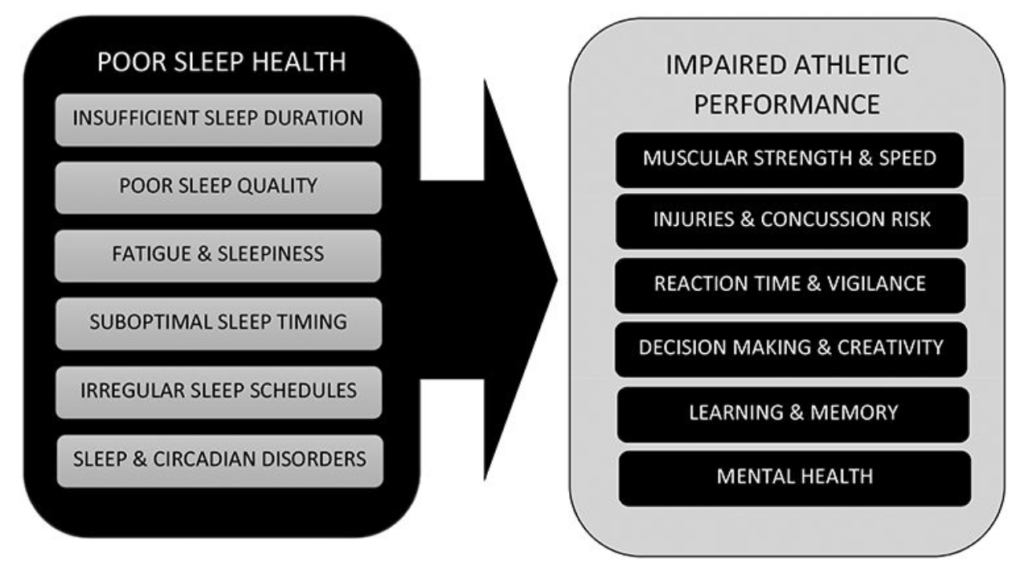
For athletes, the implications extend beyond metabolism. Sleep restriction has been associated with increased perceived exertion during standardized exercise tasks and measurable declines in reaction time and cognitive processing speed 3,4. In applied sport settings, chronic short sleep duration has been correlated with increased injury risk in adolescent and collegiate athletes, with those sleeping fewer than eight hours per night demonstrating significantly higher injury incidence 5. Glycogen restoration is also sleep-dependent; overnight carbohydrate metabolism and hormonal signaling support replenishment, and reduced sleep opportunity compresses this recovery window.
These effects are not catastrophic in isolation. A single short night rarely collapses performance. The risk lies in repetition. Thirty to sixty minutes lost each evening does not feel severe, yet over weeks it produces chronic under-recovery. The performance athlete rarely fails because of acute sleep loss. He plateaus because of cumulative insufficiency.
Cognitive arousal compounds the problem. Digital platforms are engineered for novelty and intermittent reinforcement. Emotional variability—outrage, humor, controversy—keeps the nervous system engaged. Transitioning from that state directly into sleep is physiologically incongruent. The sympathetic nervous system remains activated, sleep latency increases, and sleep architecture can fragment. Slow-wave sleep, critical for physical restoration, and REM sleep, essential for learning and emotional regulation, are both sensitive to insufficient duration and late-night stimulation. Over time, the deficit accumulates.
Nutrition follows a similar pattern of subtle erosion. Distracted eating reliably increases caloric intake. When attention is diverted, interoceptive cues are dampened. Satiety signals are delayed or ignored. Exposure to food advertising and delivery platforms increases impulsive ordering. Late-night wakefulness extends feeding windows. For athletes managing body composition, the issue is rarely extreme binge episodes. It is caloric drift—an additional two to three hundred calories, inconsistently acknowledged, sustained across weeks. Energy balance does not require dramatic excess to shift. A modest, chronic surplus is sufficient to prevent body re-composition or reverse a caloric deficit.
Training quality suffers through attentional fragmentation. Adaptation depends not only on sets and reps, but on intent. Neural drive, coordination, and skill acquisition are enhanced by sustained focus. When rest periods are interspersed with unstructured scrolling, they become undefined. Five minutes becomes eight. Intensity wanes. The session is completed but not optimized. I have experienced this personally, picking up the phone between sets and feeling the edge of focus dull. The difference is difficult to quantify, yet unmistakable. Performance outcomes are sensitive to these margins.
The phone also influences behavior before the session even begins. Procrastination often disguises itself as brief distraction. Ten minutes of scrolling can delay mobility work, shorten a warm-up, or compress training time when our schedules are already tight. For high performers balancing careers, fatherhood, and competition, time is already constrained. Unstructured phone use quietly steals from preparation.
Cognitive performance beyond the gym is not exempt. Frequent task switching degrades working memory efficiency and increases the time required to re-engage complex tasks. The brain adapts to rapid novelty cycles by recalibrating its tolerance for sustained effort. Reading becomes harder. Deep work becomes uncomfortable. Strategic thinking, whether in business or training design, requires uninterrupted attention. When that capacity erodes, decision quality follows.
It is important to acknowledge that phones are not inherently adversarial. They provide access to education, training data, communication, and business infrastructure. For many athletes, they are indispensable tools. The tension lies not in ownership, but in constraint. A tool without boundaries becomes an environmental stressor. High performers do not eliminate stress; they manage it. The same logic should apply to attention.
The compound effect of unstructured phone use is decisive. Slightly reduced sleep, marginally elevated caloric intake, diluted training intent, and fragmented cognition may each appear tolerable. Together, they produce stagnation. The athlete believes he is doing most things right. The visible variables are in place. The invisible variable—attention allocation—remains unexamined.
Application, therefore, should be principled rather than extreme. The objective is not digital abstinence. It is environmental design.
- Sleep deserves protection. Charging devices outside the bedroom removes temptation at the moment discipline is lowest. Establishing a defined cutoff window—thirty to sixty minutes before bed—reduces both time displacement and cognitive stimulation. Replacing scrolling with low-arousal activities allows the nervous system to transition appropriately.
- Nutrition benefits from singular focus. Eating without simultaneous scrolling restores awareness of satiety cues. Decisions about ordering food can be made deliberately earlier in the day, rather than reactively at night. Extending wakefulness should not automatically extend feeding.
- Training demands intent. Airplane mode during sessions preserves rest precision and focus. If filming is necessary, it can be bounded to specific sets rather than default behavior. The gym is a place for output, not consumption.
- Work and leadership at home require presence. Defined notification windows protect deep work. Physical separation from the device during family time elevates relational quality. High standards are modeled, not announced.
Practical Takeaways for High Performers
If the goal is performance across sleep, physique, cognition, and leadership, the following standards are worth adopting:
- Establish a fixed device cutoff window before bed (30–60 minutes minimum).
- Charge the phone outside the bedroom or away from the bed to remove default temptation.
- Do not eat while scrolling. Separate meals from screens.
- Use airplane or focus modes during training sessions unless filming is intentional and bounded.
- Define notification windows rather than allowing constant interruption.
- Protect the first 30 minutes of the morning from reactive phone use.
- Treat attention like training load: finite, trackable, and worth protecting.
The broader principle is this: attention is a performance resource. It is finite. It can be squandered or protected. High performers already understand the necessity of managing training load and recovery capacity. The modern extension of that understanding is managing digital engagement.
This is not a condemnation. It is an accounting exercise. I continue to adjust my own behavior because I see the difference when I do. Sleep improves. Nutrition stabilizes. Training sharpens. Conversations deepen. None of these changes are dramatic. They are incremental. Over time, incremental shifts determine trajectory.
If performance truly matters—across career, fatherhood, marriage, and competition—attention must be budgeted with intention. The phone is not the enemy. Unconstrained use, however, carries measurable cost. High standards begin where convenience ends.
ADDITIONAL RESOURCES
- Buxton OM, Cain SW, O’Connor SP, et al. Adverse metabolic consequences in humans of prolonged sleep restriction combined with circadian disruption. Sci Transl Med. 2012;4(129):129ra43. doi:10.1126/scitranslmed.3003200
- Spiegel K, Leproult R, Van Cauter E. Impact of sleep debt on metabolic and endocrine function. Lancet. 1999;354(9188):1435-1439. doi:10.1016/S0140-6736(99)01376-8
- Fullagar HHK, Skorski S, Duffield R, Hammes D, Coutts AJ, Meyer T. Sleep and athletic performance: the effects of sleep loss on exercise performance, and physiological and cognitive responses to exercise. Sports Med. 2015;45(2):161-186. doi:10.1007/s40279-014-0260-0
- Lim J, Dinges DF. A meta-analysis of the impact of short-term sleep deprivation on cognitive variables. Psychol Bull. 2010;136(3):375-389. doi:10.1037/a0018883
- Milewski MD, Skaggs DL, Bishop GA, et al. Chronic lack of sleep is associated with increased sports injuries in adolescent athletes. J Pediatr Orthop. 2014;34(2):129-133. doi:10.1097/BPO.0000000000000151